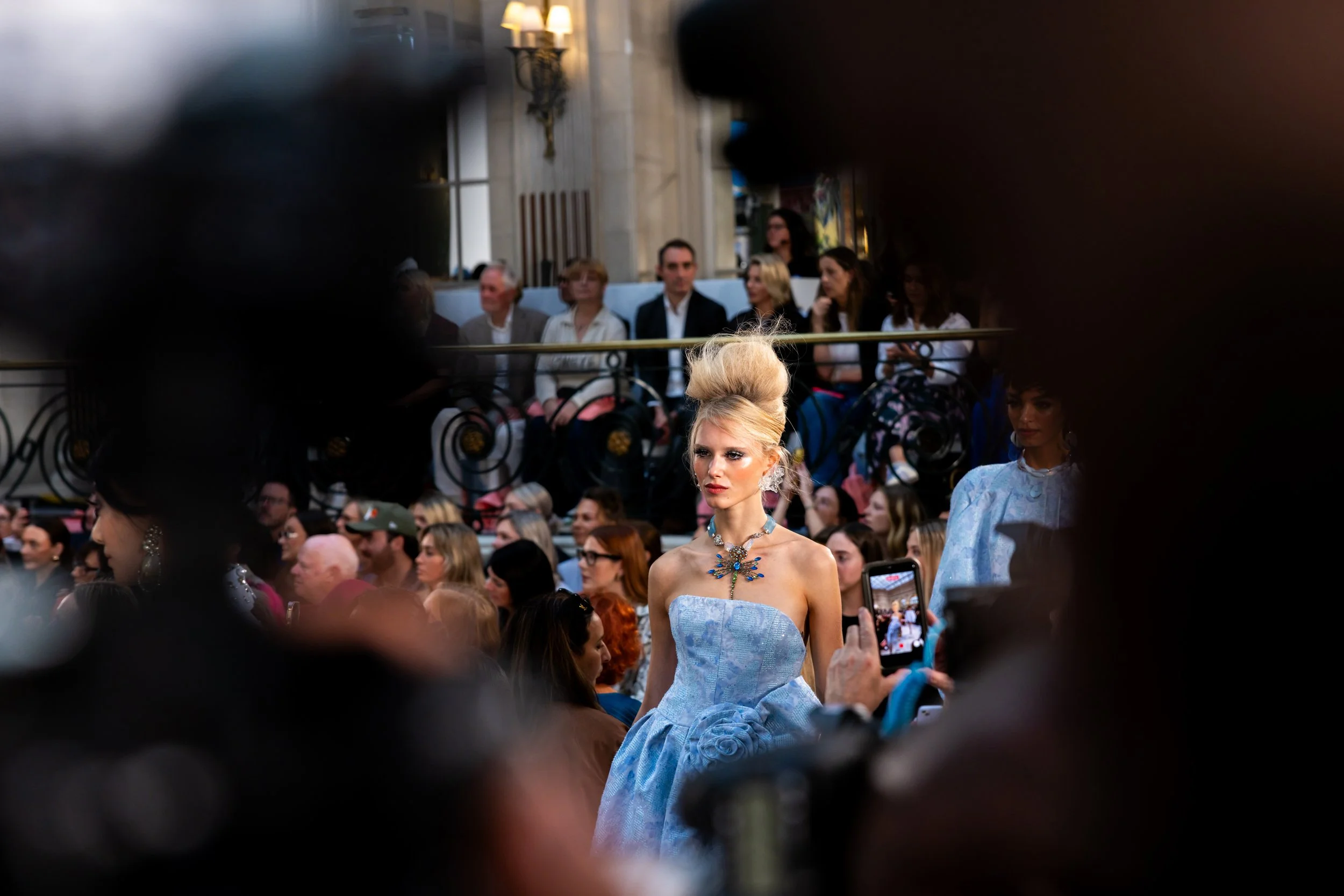
Camera Settings for Fashion Week Photography
Fashion Week is one of the most demanding environments a photographer can step into. The light changes constantly, models move fast, and you are sharing a tiny strip of space with photographers who have been doing this for years.
Getting great images is not just about having the right camera. It is about understanding the rhythm of the runway, respecting the people around you and setting your camera up so it can handle chaos.
These are the settings and working habits I use when shooting both runway and backstage at Fashion Week.
Fashion Week is not a studio
If you come into Fashion Week with studio habits, you will struggle.
Lighting is unpredictable. People move without warning. You get one chance at each look. You cannot ask a model to repeat a walk because your shutter speed was too slow.
Your camera needs to be set for speed, not perfection.
Riser etiquette – where you stand matters
On the runway, space is everything.
Most shows have a narrow riser packed with photographers, many of whom have been there for years. Their positions are not accidental. They earned them.
A few simple rules will keep you on the right side of everyone:
Tape out your footprint so you do not creep forward
Never push in front of someone
Do not swing long lenses into other people’s space
Stay in your lane
One of the best pieces of advice I ever got was to bring a small folding stool. It gives you height without taking more space, and it stops you blocking people behind you.
Be respectful. Fashion is a small world and reputations travel fast.
Flash – what is allowed and what is not
This is a big one.
Backstage:
Flash is usually allowed and often essential. Backstage areas are dark and chaotic. A little flash freezes motion and cuts through messy lighting.
Runway:
Never use flash.
It distracts models, ruins the lighting design and can get you removed from the show.
If you only remember one rule, make it that.
My runway camera settings
On the runway, the goal is to freeze motion and keep outfits sharp.
My typical starting point is:
Shutter speed: 1/250s to 1/500s or faster
Aperture: f/2.8 to f/4
ISO: high enough to support both
Focus: Continuous (Servo AF) with eye detection
Drive: Fast burst mode
Mode: Manual
I prioritise shutter speed over noise. A slightly grainy image is far better than a soft one.
My backstage camera settings
Backstage is a different world.
People are moving in every direction, lighting is terrible, and moments happen in seconds.
Here I usually shoot:
Wider apertures for light and separation
Fast shutter speeds to stop motion
High ISO without worrying too much about noise
Continuous autofocus locked to faces or eyes
If flash is allowed, I will use it gently to clean up skin tones and freeze movement.
Focus and burst mode
Fashion is movement.
Always use:
Continuous autofocus
Eye or face detection
Fast burst mode
You are not spraying and praying. You are giving yourself multiple chances to capture the exact moment when the look, the posture and the light line up.
Manual mode saves you
Fashion Week lighting changes constantly. Spotlights, LEDs, screens and mixed colour temperatures will confuse auto modes.
Manual mode lets you:
Lock your shutter speed
Control your depth of field
Adjust ISO quickly as lighting changes
Once you get used to it, it is far faster than fighting your camera.
The mistake most beginners make
They try to keep ISO too low.
That forces slow shutter speeds, which leads to blurred hands, hair and garments. Fashion is about detail. You need sharpness more than you need clean files.
Push the ISO. Get the shot.
Final thought
Fashion Week is not about showing off. It is about being prepared, being respectful and being ready when the moment happens.
Set your camera for speed. Respect the people around you. Deliver images people can actually use.
That is how you build a reputation in this world.